8 Irrigation management
Introduction
Irrigation management is one of the most important factors influencing wheat yield and quality in the Pacific Northwest. Wheat yield potential is determined by three key components: the number of heads per unit area, the number of kernels per head, and the average grain weight. These yield components are influenced by water availability at different growth stages.
Moisture stress at any growth stage before the grain soft dough phase can reduce wheat yields; however, adequate soil moisture during the tillering and boot-to-flowering stages has the most significant impact on yield components. Drought conditions during the tillering and boot-to-flowering stages may lead to reduced head formation, kernel number, and, ultimately, the greatest yield reductions.
Effective irrigation scheduling is essential for optimizing yield and water use efficiency. Irrigation scheduling determines the amount of water to apply and aligns water applications with crop requirements in a timely manner. Efficient scheduling requires knowledge of crop water use (evapotranspiration) and plant-available soil moisture, which is based on soil water holding capacities. The next three subsections provide guidance on crop water use, soil water holding capacity, and irrigation systems and scheduling for irrigated wheat production systems in the Pacific Northwest.
Crop water use and evapotranspiration
Soil Available Water-Holding Capacity
Available Water-holding Capacity of Soil
The amount of water a soil will store for crop use is called the available water-holding capacity (AWHC) and is typically expressed as inches of water per foot of soil depth (inches/foot). AWHC is determined by the soil’s texture, structure, and organic matter content, all of which influence the ability of soil to retain moisture in a form available to plants.
Available water-holding capacities vary widely among soil texture types found in the Pacific Northwest. Loamy soils usually have AWHC values above 2 inches/foot, making them ideal to support consistent crop growth. Sandy soils typically hold less than 1 inch of available water per foot due to their larger pore spaces and lower surface area. Sandy loam soils generally fall somewhere in between these two extremes and are common in many irrigated agricultural regions of the Pacific Northwest.
Available water-holding capacities for most agricultural soil series found in southern Idaho are listed in Table 10. For more detailed site-specific information, consult University of Idaho CIS 236, Available Water-holding Capacities of Soils in Southern Idaho, which provides AWHC estimates of soils where irrigated wheat is commonly grown. The AWHC of a soil profile varies with depth, as soil texture at different depths can vary considerably throughout the root zone. To calculate the total AWHC of a field for wheat production, first determine the thickness and texture of each soil layer within the effective root zone, which is typically around 3 feet for wheat. Then, apply the AWHC value for each layer to estimate total water storage. For example, a soil profile that is sandy in the top foot but transitions to sandy loam in the second and third feet will have different water-holding characteristics in each layer. An example calculation is shown in Table 8.1.
If you are interested in determining the AWHC for a specific field or location, the USDA Web Soil Survey is a valuable resource.
Total AWHC of a soil profile represents the total available soil moisture (ASM) in inches between irrigation events that is available for crop uptake. Understanding ASM is essential for setting appropriate irrigation thresholds and avoiding under- and over-irrigation.
Determining Available Soil Moisture
Available soil moisture can be determined through direct measurement of soil water content or estimated using crop evapotranspiration (ET) values from local weather data. Direct measurements of ASM include:
- Soil feel and appearance (manual evaluation)
- Gravimetric sampling (weighing samples before and after oven drying)
- Soil moisture sensors such as tensiometers, time-domain reflectometry (TDR), or capacitance probes.
One of the most practical methods of estimating soil moisture depletion is called the “water budget” or “checkbook” method (see PNW 288, Irrigation Scheduling, and University of Idaho MS 39, Soil Moisture Scheduling Card). Once the soil has drained to field capacity (generally 1 to 2 days after full irrigation), further losses of soil moisture occur primarily through ET. If the AWHC of the full soil profile and the amount of soil moisture lost to ET each day are known, then ASM can be estimated by subtracting the sum of the daily ET values from the initial soil water content.
Today, ET data are widely available through state and regional weather networks (e.g. AgriMet and OpenET), on-farm weather stations (e.g. METER Group, Davis Instruments, Campbell Scientific, etc.), and irrigation scheduling tools. Remember, while water budgets provide useful estimates of soil moisture depletion, periodic field-based measurements (using soil moisture sensors or manual checks) are recommended to validate estimates for more accuracy.
| Soil type per layer | Soil layer thickness | Available WHC | WHC per soil layer | ||
|---|---|---|---|---|---|
| (feet) | (inches/foot) | (inches) | |||
| Sandy | 1.0 | x | 1.0 | = | 1.0 |
| Sandy Loam | 2.0 | x | 1.5 | = | 3.0 |
| Total ASM (inches) | 4.0 |
Irrigation systems and scheduling
Irrigation Scheduling
Research conducted in southern Idaho under sprinkler irrigation has shown that maintaining soil moisture levels in the root zone above 50 percent available soil moisture (ASM) throughout the growing season is fundamental for achieving maximum wheat yields (Table 12). During critical growth stages such as tillering and flowering, soil moisture levels should be maintained above 60 percent ASM due to the crop’s greater sensitivity to water stress during these growth stages.
For example, in a soil with a total available water-holding capacity (AWHC) of 4 inches in the top 3 feet of the soil profile, irrigation should occur before soil water depletion exceeds 2 inches (50 percent ASM). The use of soil moisture sensors (if field capacity and permanent wilting point are known) or the water budget (checkbook) method can be used to track cumulative soil water depletion and guide irrigation decisions. Overirrigation should be avoided, particularly during tillering, when crop water needs are relatively low and only light irrigations are normally required. Excessive irrigation during this time can move available nitrogen below the root zone through leaching, which may reduce both yield and quality.
Recommendations for Different Irrigation Systems
Center Pivot Systems - Center pivot irrigation systems often cannot apply enough water to match peak daily ET values of wheat. For example, in July, a center pivot will apply approximately 0.25-0.30 inches per day, while ET rates may exceed 0.30 inches per day (Fig. 2). Under these high-demand conditions, crops will rely on soil moisture reserves that were built up earlier in the season.
To prepare for peak demand, center pivot systems should be started early in the growing season and kept on until the root zone reaches field capacity (100 percent ASM), or until water has penetrated 2.5 to 3 feet into the soil. Root zone soil moisture levels should be 100 percent ASM by mid-June. After this point, irrigation should be managed to maintain field capacity or at least maintain ASM above 50 percent throughout the remainder of the season.
During peak ET periods (Figure 8.1), center pivot systems may need to be operated continuously with one rotation completed every 36 hours. In fields that are prone to runoff, conservation tillage practices or residue management can help minimize erosion. As ET demands decline later in the season (Figure 8.1), pivot application capacity will meet or exceed ET demands, allowing soil moisture to be replenished.
Surface Systems - By the time the first irrigation is applied, a normal wheat crop will typically have roots established to a depth of 1 foot. During the initial irrigation events with gravity systems, infiltration rates are often high, leading to overirrigation. Except in light, sandy soils, the first irrigation should be delayed until soil moisture levels decline to 40 percent ASM at a 4- to 6-inch depth. This depletion level usually corresponds to late tiller development. In areas with dry winters, fall pre-irrigation may be required to ensure adequate soil moisture at planting. However, spring pre-irrigation in dry winter areas may delay seeding dates due to wet field conditions. Soil moisture levels should be maintained at or above 60 percent ASM from the boot to flowering growth stages. Soil moisture levels can be reduced to 50 percent ASM between irrigations, but should not be reduced further.
Wheel Line and Hand-Move Systems - For wheel line (a.k.a., side-roll) and hand-move sprinkler systems, the first irrigation should wet the soil to a depth of 6-8 inches. To prevent water stress, initial sets should be scheduled early enough that ASM does not fall below 50 percent (60 percent during tillering and from booting to flowering) at the 4–6-inch depth on the final set of the first irrigation pass.
The second irrigation pass should apply enough water to recharge the soil profile down to sub-surface moisture, which may require 12- to 24-hour sets, depending upon soil type, texture, and rooting depth. To reduce the number of irrigations on medium-textured soils and save labor, subsequent irrigations can be set to 24-hour intervals. These irrigations should be timed to avoid soil moisture depletion below 60 percent ASM levels on the final set. Because it takes longer to cover a field with 24-hour sets, the conversion from 12-hour to 24-hour sets should begin early enough to avoid excessive depletion of ASM before the final set.
Scheduling the Last Irrigation
Unnecessary irrigation late in the season wastes water, increases energy costs, heightens the risk of lodging, and reduces profitability. In many cases, irrigators apply more late-season irrigation than is necessary for optimum yields.
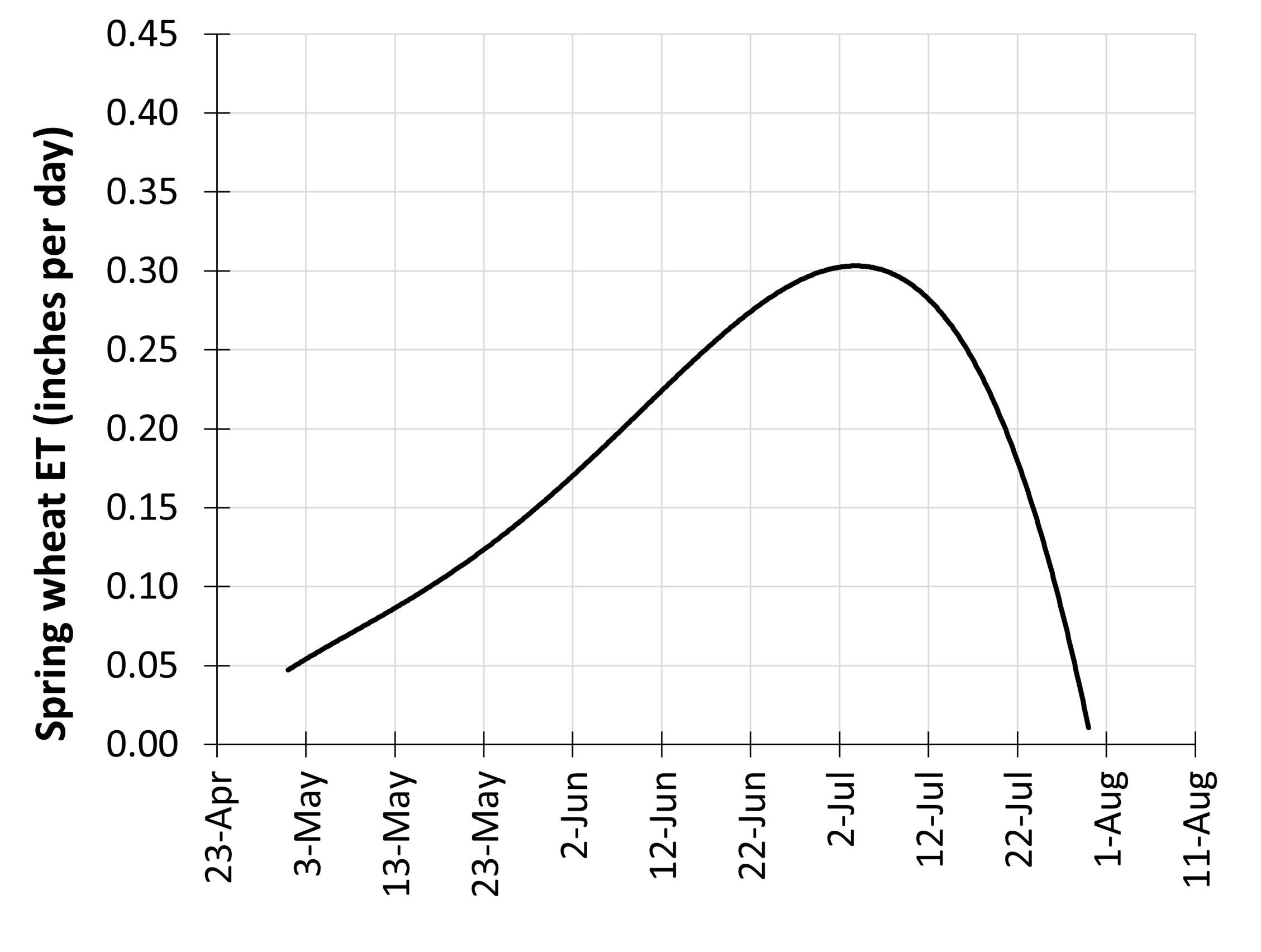
As shown in Figure 8.1, from the soft dough stage to maturity, wheat requires approximately 2.5 inches of ASM. At the soft-dough stage, kernels are fully formed and exude a dough-like texture when pressed between the thumb and index finger.) On soils with a total AWHC of 2.5 inches or greater, the final irrigation can be applied at the soft dough stage. On soils with a total AWHC of less than 2.5 inches, irrigation after the soft dough stage may be required, but total water applied beyond the soft dough stage should not exceed 2.5 inches.
Resources
Estimating Water Requirements of Hard Red Spring Wheat for Final Irrigation