10 Integrated pest management
Introduction
Integrated pest management (IPM) is an approach to managing insects, diseases, weeds, and other pests that aims to keep pest populations and pest-related damage below levels that reduce yield or profitability, while limiting unnecessary costs and undue risks to human and environmental health. As the name suggests, IPM employs the integration of an array of pest management tactics and tools, avoiding reliance on any one pest management practice and combining tactics with different strengths to achieve consistent pest management results. Those same IPM goals and practices also promote plant and soil health benefits to optimize on-farm economic sustainability.
Creating an IPM program starts with knowledge of pest biology (e.g., information about its lifecycle) as well as knowledge of how the pest interacts with the crop (e.g., how and when the pest is most likely to cause economic damage). This information is used to select the most effective and appropriate management tools. IPM programs often have preventive and low-input management practices at their core, while allowing for more intensive, corrective measures when necessary.
This chapter describes the general principle and process of IPM as they apply to wheat production. Subsequent chapters in this guide provide detailed information on specific wheat pests, including their biology, impacts, monitoring, and management options.
The IPM Process
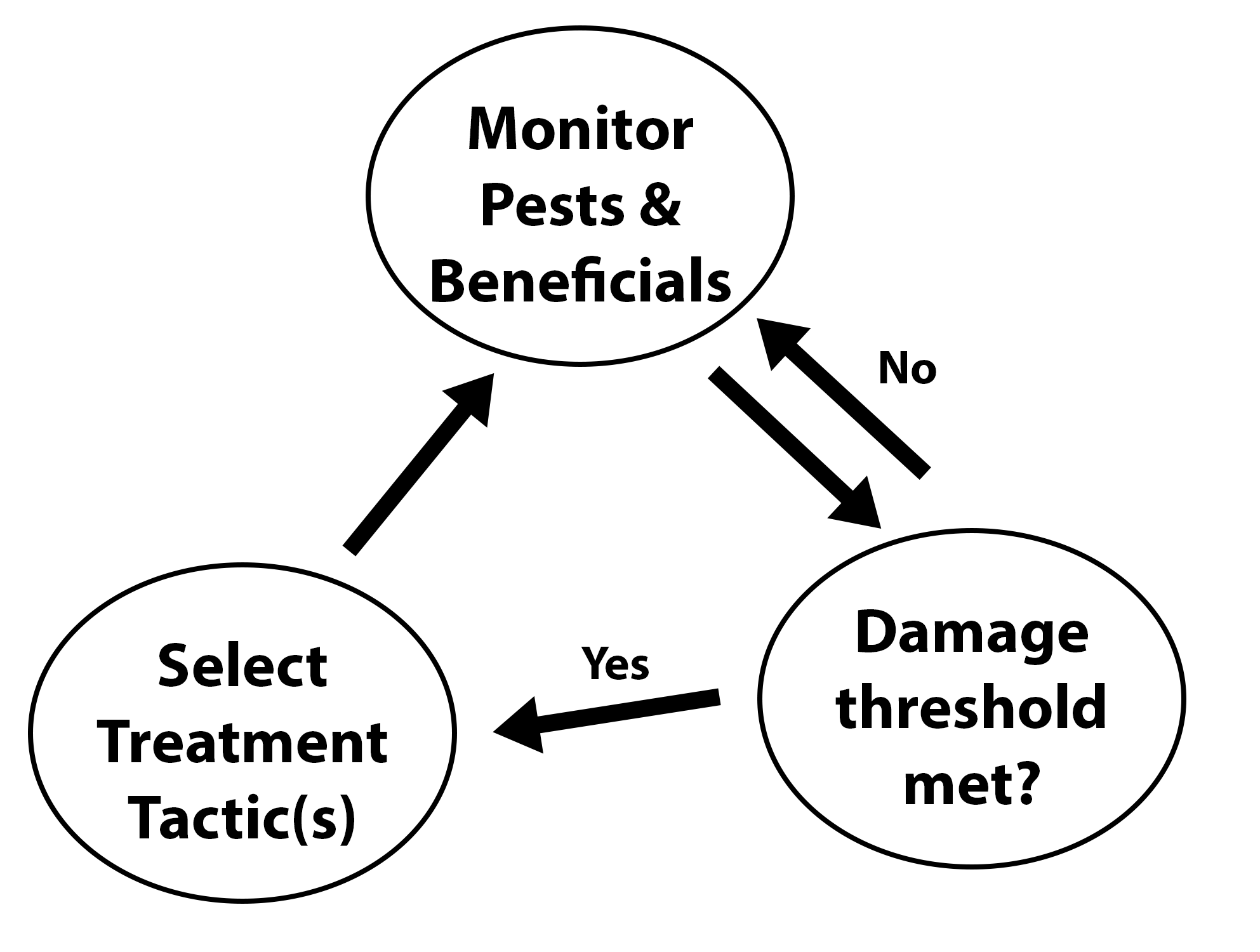
IPM follows a cycle of observation, data-based decision-making, and evaluation:
- Monitor – Scout fields to determine which pests and beneficial organisms are present, where they occur, how abundant and degree of damage.
- Assess – Use findings and knowledge of crop-pest interactions to determine if intervention to reduce pest populations is warranted.
- Manage – If assessments indicate pests pose a significant threat to yield and profitability, select and implement appropriate management tactics.
- Evaluate – Continue monitoring to assess the effectiveness of management actions and adjust future decisions as needed.
This process repeats throughout the growing season and across years, allowing producers to refine management strategies over time and bolster preventive management before outbreaks can occur each season.
1. Monitoring
Pest monitoring is the foundation of any successful IPM program. Monitoring may be used to:
- Detect the presence or timing of pest activity (e.g., determining when an insect has emerged or moved into a field)
- Estimate pest density or distribution within a field
- Track populations of beneficial organisms that help suppress pests
Timing monitoring efforts strategically with crop and pest lifecycles is essential for success. Pests differ in when they are active, when they are likely to cause damage, and how much damage they can inflict. Understanding pest life cycles helps target scouting efforts to the periods when damage is most likely to occur. Detailed monitoring methods are described in subsequent pest-specific chapters of this guide. Understanding a few key concepts can also help ensure your monitoring program is efficient and successful.
Pest emergence and population development can often be anticipated using predictive tools. Many pests’ growth and development are driven by temperature, humidity, and other abiotic factors. Therefore, we can often use recent and forecasted weather to predict the timing of emergence and outbreaks. This can be as simple as recognizing that weather forecasts may favor the outbreak of a certain pest. However, there are also data-driven tools to make such predictions. Growing degree days (GDD) are one such tool. GDD are a measure of accumulated heat units used to estimate the timing of plant and pest development. Accumulated degree days can help predict when key developmental stages are likely to occur, allowing scouting to be timed more precisely.
Representative sampling across the field is essential to obtain accurate information and support sound management decisions. Pests are rarely uniformly distributed throughout a field. Variation in field conditions, pest point of introduction, and other factors usually create areas with higher pest density. Scouting a variety of locations with different characteristics throughout your field helps capture this variability and reduces the risk of over- or underestimating pest population sizes and damage. Such scouting can also facilitate targeting management to localized infestations, reducing input costs and minimizing risks to beneficial organisms.
Scouting timing and methods should be selected strategically to collect the specific data needed to inform management decisions, particularly when using action or economic thresholds. Monitoring should produce actionable data. Often, this means scouting before and during periods of crop and pest development where economic damage is most likely. This may also mean using scouting practices that can produce data to guide action or economic threshold-based decision making. For instance, some thresholds may be based on the number of insects per plant. In such a case, it is important to collect this type of data during field scouting.
2. Assessing the Need for Management
Determining whether pest management is necessary is another key component of an IPM program. It is rarely advisable to try to completely eliminate all pests. Instead, producers must determine whether a pest is causing enough damage to warrant the costs and consequences of treating it with a particular management strategy. Ideally, this determination is made based on monitoring data, understanding of crop-pest interactions, and science-based recommendations. These recommendations often include pest-abundance levels or damage values (thresholds) that should be observed before treatment is deemed justified. There are a few key terms to understand when interpreting threshold recommendations for pest management:
- Damage threshold – The level of injury a crop can sustain without measurable yield loss.
- Economic injury level (EIL) – The lowest pest density at which the cost of damage equals the cost of control.
- Action threshold (AT)/Economic threshold – The pest density or damage level at which action should be taken to prevent reaching the economic injury level.
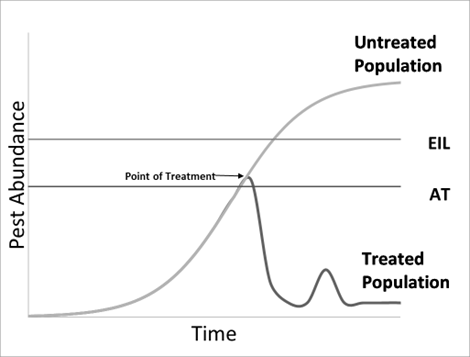
For many wheat pests, research-based action thresholds are available and should be used whenever possible. In some situations, there may be insufficient research to establish an exact threshold. In such cases, assessment relies on informed judgment and consideration of several factors:
Potential yield loss based on crop stage and pest pressure
Crop condition, value, and vigor, including moisture and nutrient status
Expected pest population trends, based on life cycle and environmental conditions
Costs and consequences of treatment, including implementation or application costs for selected management practices, impact to beneficial organisms, and risk of secondary pest outbreaks, resistance development, environmental impact, etc.
Accepting some level of pest presence or damage is often part of effective IPM. Treating too early or too aggressively can increase costs and create additional pest management challenges later in the season. Using established thresholds and keeping tenets of IPM decision-making in mind can help avoid these costs.
Management Options in IPM
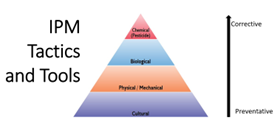
When the monitoring data indicates that management is necessary, IPM emphasizes selecting tactics that are effective, economical, and that reduce risk. IPM relies on integrating multiple management approaches rather than depending on a single tool, such as timed or scheduled pesticide applications. Often, IPM programs are built upon preventive tactics, relying on intensive, corrective tactics only when the expense and risk are justified by the extent of pest pressure. Here, management types are discussed generally. Subsequent chapters outline recommended practices for specific pest concerns.
Cultural Management
Strategic modification to the production environment can reduce the likelihood or severity of pest problems and make plants more resilient to damage. Many cultural decisions are made before planting and can have long-lasting impacts.
Examples of cultural management in wheat include:
- Selecting adapted varieties with resistance or tolerance to key diseases or insects
- Using crop rotation to reduce buildup of pests that survive in crop residue or soil
- Managing fertility and irrigation for optimum plant health
- Altering seeding practices such as seeding dates, seeding rates, or row spacing
- Adjusting planting dates to avoid peak pest pressure
Mechanical and Physical Management
Mechanical and physical management tactics physically disrupt pests or limit their ability to damage the crop. These tactics aim to remove, exclude, reduce, or kill pests by physical or mechanical means.
Examples include:
- Tillage practices that reduce populations of some pests or pathogens, often by directly killing them or promoting conditions that reduce survival
- Residue management to remove or kill overwintering pests
Biological Management
Biological control involves the use of a living organism to manage a pest. These organisms often include predators, parasitoids, and pathogens. In wheat systems, biological control is most often achieved through conservation of existing beneficial organisms.
Practices that support biological control include:
- Avoiding unnecessary pesticide applications
- Reducing use of broad-spectrum products when more selective alternatives are available
- Maintaining field edges or landscapes that support beneficial insects
Chemical Management Within IPM
Pesticides are important tools in wheat production and are often a necessary part of IPM programs. Within IPM, chemical control is used strategically and in combination with other practices to achieve effective and sustainable pest reduction.
Key principles for effective chemical applications include:
Optimize application timing – Effective chemical management ensures that the chemistry used targets the life stage of pest present (e.g., egg, larva, or adult), while planning for any lag time between application and population reduction (as with a systemic pesticide).
Resistance management – Rotating modes of action and avoiding unnecessary applications preserves the effectiveness of available products. Repeated use of products with the same mode of action increases the risk of pest populations developing resistance.
Selectivity – Choosing products that target the pest while minimizing impacts on beneficial organisms can improve long-term control.
Avoiding pest resurgence and secondary pest outbreaks – Broad-spectrum pesticides can reduce populations of natural enemies (predators, parasitoids, and beneficial fungi, bacteria, and nematodes) and competition amongst pests, sometimes leading to rapid rebound of the target pest or outbreaks of secondary pests.
Always follow label directions – including rates, timing, and restrictions – to promote product efficacy and limit risks to the crop, the applicator, and non-target organisms. Pesticide labels are legal documents, and misuse can pose risks to human health, non-target organisms, and the environment.
Putting IPM Into Practice
Integrated pest management is a framework that supports informed decision-making and economically sound pest management. By combining monitoring, science-based management thresholds, cultural practices, biological control, and careful use of pesticides, producers can manage pests effectively while protecting yield, profitability, and the long-term sustainability of wheat production systems.