4 Wheat varieties and breeding
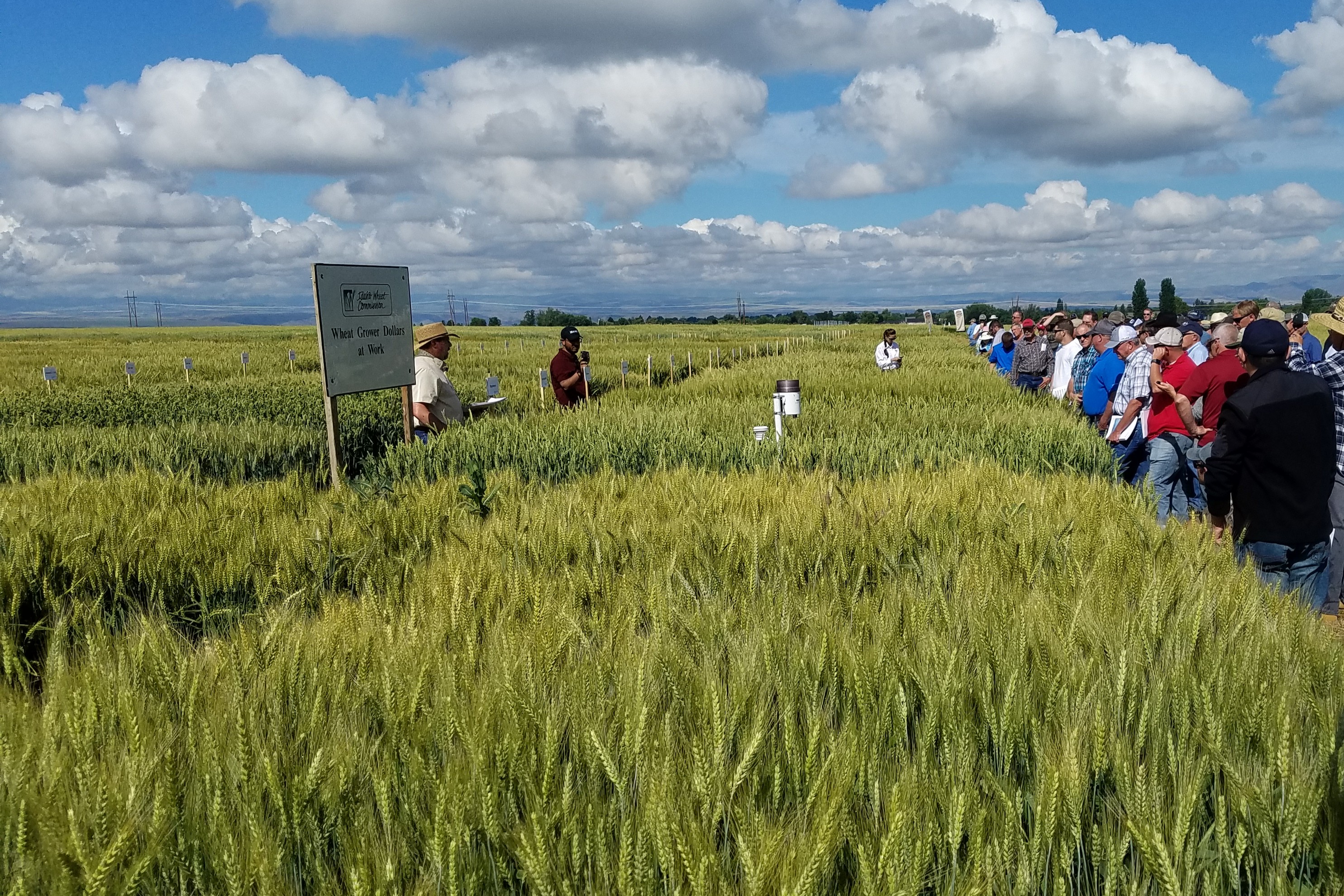
Key attributes for Idaho production conditions
Idaho’s wheat production contributes significantly to both domestic and international wheat markets. Nationally, Idaho ranks among the top eight states for wheat and wheat-product exports, with approximately 50% of the wheat grain production destined for the export market.
Improved grain yield and end-use quality are the two most vital traits required for new wheat cultivars. To maintain the competitiveness of Idaho wheat growers and support the market demand for Idaho wheat, it is essential to continuously increase the crop’s productivity by developing wheat varieties with high yield, premier quality, and resistance or tolerance to major biotic and abiotic stresses.
Preferred Wheat Varieties for the PNW
2026 Preferred Wheat Varieties - This annual brochure is produced jointly by Washington, Oregon, and Idaho Wheat Commissions to provide quality data for varieties grown in the Pacific Northwest.
Varieties are statistically ranked by class, based on a minimum of three years’ end-use quality data in a cross-environment study conducted by the USDA-ARS Western Wheat Quality Lab (WWQL) in Pullman, WA.
Learn more about quality testing and grading in Chapter 19, End-use quality.
Wheat Cultivar Development at the University of Idaho
The University of Idaho has two breeding programs: one located on Moscow campus in the Northern panhandle of the state, and another located in Aberdeen Research & Extension Center in Southeast Idaho. The northern program focuses on the soft white winter wheat development in partnership with Limagrain Cereal Seeds (LCS). The southern program focuses on spring wheat development in three market classes: soft white spring, hard white spring, and hard red spring. Released cultivars from both breeding programs are included in Table 4.1 below.
Conventional Wheat Breeding
Conventional wheat breeding is the primary method being used in the two breeding programs. It follows four major stages (click to expand each stage below and learn more):
Advantages of Traditional Breeding Methods in Relation to Gene Editing
Lower cost and complexity: Conventional breeding is generally less expensive and requires less technical expertise compared to gene editing, as it relies on well-established techniques like crossing and selection.
Utilizes existing genetic resources: Conventional breeding works by selecting and combining existing genetic material naturally found within the species, making it a more traditional approach to increasing genetic resources for crop improvement.
Improve Complex Traits: For traits controlled by many genes (quantitative traits), conventional breeding is the most effective way to combine these complex genetic characteristics.
Public and Regulatory Acceptance: Conventional breeding methods are widely accepted by the public and are not subject to the same strict regulations and labeling requirements as genetically modified (GM) crops in many regions (e.g., the EU). This facilitates market entry and the variety’s adoption.
Limitations of conventional breeding
Time-consuming: The process of crossing and selection for desirable traits can take many generations, making it a slow method of crop improvement.
Less precise: It lacks the precision of gene editing, which can be used to make specific, targeted changes without moving the entire genome. Instead, it relies on random recombination of genes during sexual reproduction, which can be less predictable.
Difficulty with novel traits: It can be challenging or impossible to introduce novel traits that do not exist within the species’ natural genetic pool.
| Stage | Generation | No. of Lines | Designation | Location |
|---|---|---|---|---|
| Creation of Genetic Variation | Crossing | 800 | 2, 3, or 4 parents | Moscow/Aberdeen, Idaho |
| F1 | 800 | Headrows | Moscow/Aberdeen, Idaho | |
| Inbreeding | F2 | 750 | Bulk population | Moscow/Aberdeen, Idaho |
| F3 | 400 | Bulk population | Moscow/Aberdeen, Idaho | |
| F4 | 200 - 300 | Bulk population | Moscow/Aberdeen, Idaho | |
| Line Evaluation | F5 | 20000 - 30000 | Head rows | Moscow/Aberdeen, Idaho |
| F6 | 1000 - 2000 | Observation yield test | 1-2 locations, Idaho | |
| Selection | F7 | 600 - 800 | Preliminary yield test | Multiple locations, Idaho |
| F8 | 200 - 300 | Elite yield test | Multiple locations, Idaho | |
| F9 | 50 - 100 | Elite yield test | Multiple locations, Idaho | |
| F10 | 8 - 15 | Regional testing | Multiple locations, ID, OR, and WA | |
| F11 | 3 - 5 | State and Regional testing | Multiple locations, ID, OR, and WA | |
| F12 | 2 - 3 | State and Regional testing, breeder seed | Multiple locations, ID, OR, and WA | |
| F13 | 2 - 3 | State and Regional testing, release | Multiple locations, ID, OR, and WA | |
| Cultivar |
New Breeding Technologies
1. CRISPR/Cas-mediated gene editing
CRISPR/Cas-mediated gene editing is revolutionizing wheat breeding by providing a faster, more precise, and efficient way to address emerging production concerns. Gene editing has accelerated the breeding process from decades to just a few years by allowing precise and targeted changes to an organism’s DNA. This targeted approach enables breeders to introduce desirable traits, such as improved yields and disease resistance, much more quickly and efficiently compared to conventional breeding methods.
Advantages of Gene Editing Technology
Higher efficiency and Precision: Gene editing technologies such as CRISPR-Cas9 can precisely target specific genes in the wheat genome, enabling gene knockout, insertion or replacement. For example, by knocking out the wheat powdery mildew-susceptible gene, a new germplasm with high resistance to powdery mildew and stable yield can be developed, shortening the breeding cycle by more than 40% compared to traditional methods.
Overcoming Genetic Limitations: Natural mutations may be closely linked to unfavorable traits and cannot be directly used in breeding. Gene editing technology can precisely modify specific genes without being affected by the linkage of unfavorable traits. For instance, although there are natural mutants lacking the TaWaxy gene for amylose synthesis in nature, they are closely linked to unfavorable traits. However, through gene editing technology, the TaWaxy gene in most adapted wheat varieties can be precisely edited to obtain wheat new germplasms with different amylose contents.
Limitations of Gene Editing Technology
Technical Imperfections: The accuracy and efficiency of gene editing still need to be improved. The off-target effect may lead to incorrect cutting of non-target DNA sequences, and the post-editing gene expression regulation mechanism is complex, making it difficult to stably and efficiently achieve the expression of target genes.
Safety and Regulatory Concerns: Gene-edited wheat involves issues such as biosafety. There are still many uncertainties about its potential impacts on the ecosystem, human health and relevant safety assessments, and regulatory systems are not yet perfected.
Fast-breeding methods
In addition to gene editing, several fast-breeding methods can effectively complement traditional breeding for wheat improvement, primarily by shortening the generation cycle, enhancing trait selection efficiency, or leveraging genetic data. The core methods are as follows:
2. Speed Breeding (SB)
Core Mechanism: By precisely controlling environmental conditions (e.g., 22-25°C daytime temperature, 15-18°C nighttime temperature, 16-22 hours of artificial light), wheat growth and development are accelerated.
Complementary Value: Shortens the wheat breeding cycle from the traditional 1-2 generations per year to 3-4 generations per year. This allows breeders to rapidly advance the inbreeding stage, which would take years to stabilize favorable traits with traditional methods alone.
3. Genomic Selection (GS)
Core Mechanism: Uses genome-wide molecular markers (e.g., SNPs) to predict the genetic potential of wheat individuals for target traits (e.g., yield, quality) without phenotypic evaluation of every offspring.
Complementary Value: Avoids the time-consuming and expensive process of field phenotyping (which often takes multiple seasons) in traditional breeding. It can screen high-potential breeding materials in the early generation (e.g., F2 or F3) with an accuracy of 70%-90% for key traits, significantly reducing the number of materials that need further field validation.
4. Doubled Haploid (DH) Technology
Core Mechanism: Converts wheat haploid cells (with 1 set of chromosomes, obtained via anther culture or wheat × maize hybridization) into diploid plants (with 2 sets of identical chromosomes) using colchicine treatment.
Complementary Value: Traditional breeding requires 5-7 generations of selfing to obtain homozygous lines; DH technology achieves 100% homozygosity in just 1-2 generations. This rapidly stabilizes elite genotypes (e.g., high-yield, stress-tolerant lines) and speeds up the release of new varieties.
Example: UI Sparrow soft white winter wheat took eight years from the initial cross made in 2011 to release in 2019.
5. High-Throughput Phenotyping (HTP)
Core Mechanism: Uses advanced tools (e.g., UAVs with multispectral cameras, ground-based sensors, AI image analysis) to quickly measure multiple phenotypic traits (e.g., plant height, leaf area, disease severity) of hundreds to thousands of wheat plants in the field.
Complementary Value: Replaces manual phenotyping (which is labor-intensive, slow, and prone to error) in traditional breeding. It can collect data on 10+ traits per plant in minutes, enabling breeders to efficiently identify individuals with superior comprehensive performance and individuals with no improvement in traits measured.
Explore Wheat Breeding in the PNW
Aberdeen Wheat Breeding Program
University of Idaho Foundation Seed Program
Varsity Idaho Lines - Varieties developed in collaboration with Limagrain Cereal Seeds
WSU Breadlab
Washington State Crop Improvement - Foundation seed, seed certification, variety descriptions and resources
Oregon State University Wheat Breeding Program
Herbicide resistant varieties
Coming soon!
Performance trials, supporting data
Universities in the PNW conduct extensive variety trials each year, testing for yield, disease reactions, wheat quality and more. Explore trial results and analyses from each program at the links below. Learn about our combined PNW variety trial database and tools in the next chapter.
North Idaho Cereals
South Central & Southeast Idaho Cereals
Southwest Idaho Cereals
Oregon Cereals
Eastern Washington Cereals
WSU Breadlab